
Original: $8.60
-70%$8.60
$2.58The Story
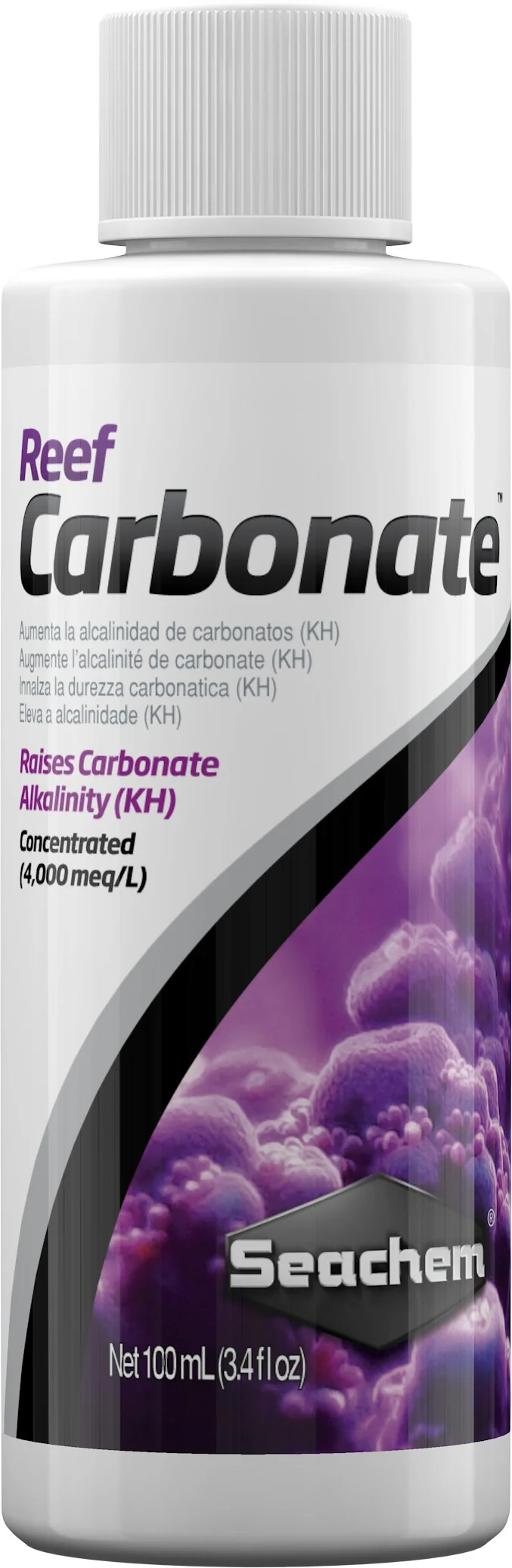
Seachem Reef Carbonate
Reef Carbonate™ is a concentrated (4,000 meq/L) optimized blend of carbonate and bicarbonate salts designed to restore and maintain alkalinity in the reef aquarium. Calcium and carbonates are essential to all coral growth. If either becomes deficient, coral growth will cease, followed by a rapid decline in coral health. To prevent this you must provide carbonates (Reef Carbonate™) and calcium (Reef Advantage Calcium™ or Reef Complete®).
Whereas competing products simply use sodium bicarbonate, Reef Carbonate™ is made with a blend of carbonate and bicarbonate salts. This blend of salts results in Reef Carbonate™ yielding a pK of roughly 9.0 in saltwater (higher than competing products). In a closed reef system, the multitude of organics produced by reef inhabitants tends to force pH downward, but the advantage of Reef Carbonate’s™ higher pK is a stabilization of pH around 8.3-8.4. Competing products’ formulations make them incapable of such a claim, so pH will always fall below desirable levels for a reef aquarium.
Used as directed, Reef Carbonate™ will not deplete calcium, magnesium, or strontium which usually tend to precipitate with increasing alkalinity. Reef alkalinity should be maintained at 3–6 meq/L (8–17 dKH). Alkalinity should not be allowed to fall below 2 meq/L.
Directions
Beginner
Use 1 capful (5 mL) per 80 L (20 US gallons) twice a week. Best if diluted into a cup of freshwater, then added. Check alkalinity every 2 weeks and adjust amount or frequency accordingly.
Advanced
Check alkalinity (use MultiTest™ Marine pH & Alkalinity to test alkalinity levels), then follow addition regimen above until alkalinity is adjusted to 4–5 meq/L. Each mL contains a minimum of 4 meq of alkalinity. Each 5 mL/80 L will raise alkalinity by about 0.25 meq/L. Amount or frequency can be adjusted, but do not exceed 20 mL/80 L per day. Thereafter, use as required to maintain alkalinity.
Expert
After determining the alkalinity consumption rate, set up a continuous drip system. Use the following formula (or skip the math and use our Dosage Calculator) to determine how much to add to your top–off water: m=va/4 (m=mL of product to add to top off water, v=volume of tank in liters, a=amount to raise alkalinity in meq/L). For example, if you want to raise alkalinity by 1 meq/L in a 200 liter tank, then you would add (200x1)/4=50 mL into the top–off water. [For reference: 1 gallon=3.8 L].
Details & Craftsmanship
Every detail has been carefully considered to bring you the perfect product.

Details & Craftsmanship
Every detail has been carefully considered to bring you the perfect product.

Details & Craftsmanship
Every detail has been carefully considered to bring you the perfect product.
Description
Seachem Reef Carbonate
Reef Carbonate™ is a concentrated (4,000 meq/L) optimized blend of carbonate and bicarbonate salts designed to restore and maintain alkalinity in the reef aquarium. Calcium and carbonates are essential to all coral growth. If either becomes deficient, coral growth will cease, followed by a rapid decline in coral health. To prevent this you must provide carbonates (Reef Carbonate™) and calcium (Reef Advantage Calcium™ or Reef Complete®).
Whereas competing products simply use sodium bicarbonate, Reef Carbonate™ is made with a blend of carbonate and bicarbonate salts. This blend of salts results in Reef Carbonate™ yielding a pK of roughly 9.0 in saltwater (higher than competing products). In a closed reef system, the multitude of organics produced by reef inhabitants tends to force pH downward, but the advantage of Reef Carbonate’s™ higher pK is a stabilization of pH around 8.3-8.4. Competing products’ formulations make them incapable of such a claim, so pH will always fall below desirable levels for a reef aquarium.
Used as directed, Reef Carbonate™ will not deplete calcium, magnesium, or strontium which usually tend to precipitate with increasing alkalinity. Reef alkalinity should be maintained at 3–6 meq/L (8–17 dKH). Alkalinity should not be allowed to fall below 2 meq/L.
Directions
Beginner
Use 1 capful (5 mL) per 80 L (20 US gallons) twice a week. Best if diluted into a cup of freshwater, then added. Check alkalinity every 2 weeks and adjust amount or frequency accordingly.
Advanced
Check alkalinity (use MultiTest™ Marine pH & Alkalinity to test alkalinity levels), then follow addition regimen above until alkalinity is adjusted to 4–5 meq/L. Each mL contains a minimum of 4 meq of alkalinity. Each 5 mL/80 L will raise alkalinity by about 0.25 meq/L. Amount or frequency can be adjusted, but do not exceed 20 mL/80 L per day. Thereafter, use as required to maintain alkalinity.
Expert
After determining the alkalinity consumption rate, set up a continuous drip system. Use the following formula (or skip the math and use our Dosage Calculator) to determine how much to add to your top–off water: m=va/4 (m=mL of product to add to top off water, v=volume of tank in liters, a=amount to raise alkalinity in meq/L). For example, if you want to raise alkalinity by 1 meq/L in a 200 liter tank, then you would add (200x1)/4=50 mL into the top–off water. [For reference: 1 gallon=3.8 L].